Bookkeeping vs. Accounting: What’s the Difference?
Bookkeeping and accounting work together, but they’re not the same. Learn the difference and why clean books matter for your small business.
BOOKKEEPING TIPSBUSINESS FINANCE BASICS
6/30/20263 min read
Bookkeeping vs. Accounting
If you own a small business, you’ve probably heard the words “bookkeeping” and “accounting” used together a lot.
And if you’ve ever thought, “Aren’t those basically the same thing?” — you’re definitely not alone.
They work together, but they are not the same. Think of them like two people on the same team, just playing different positions.
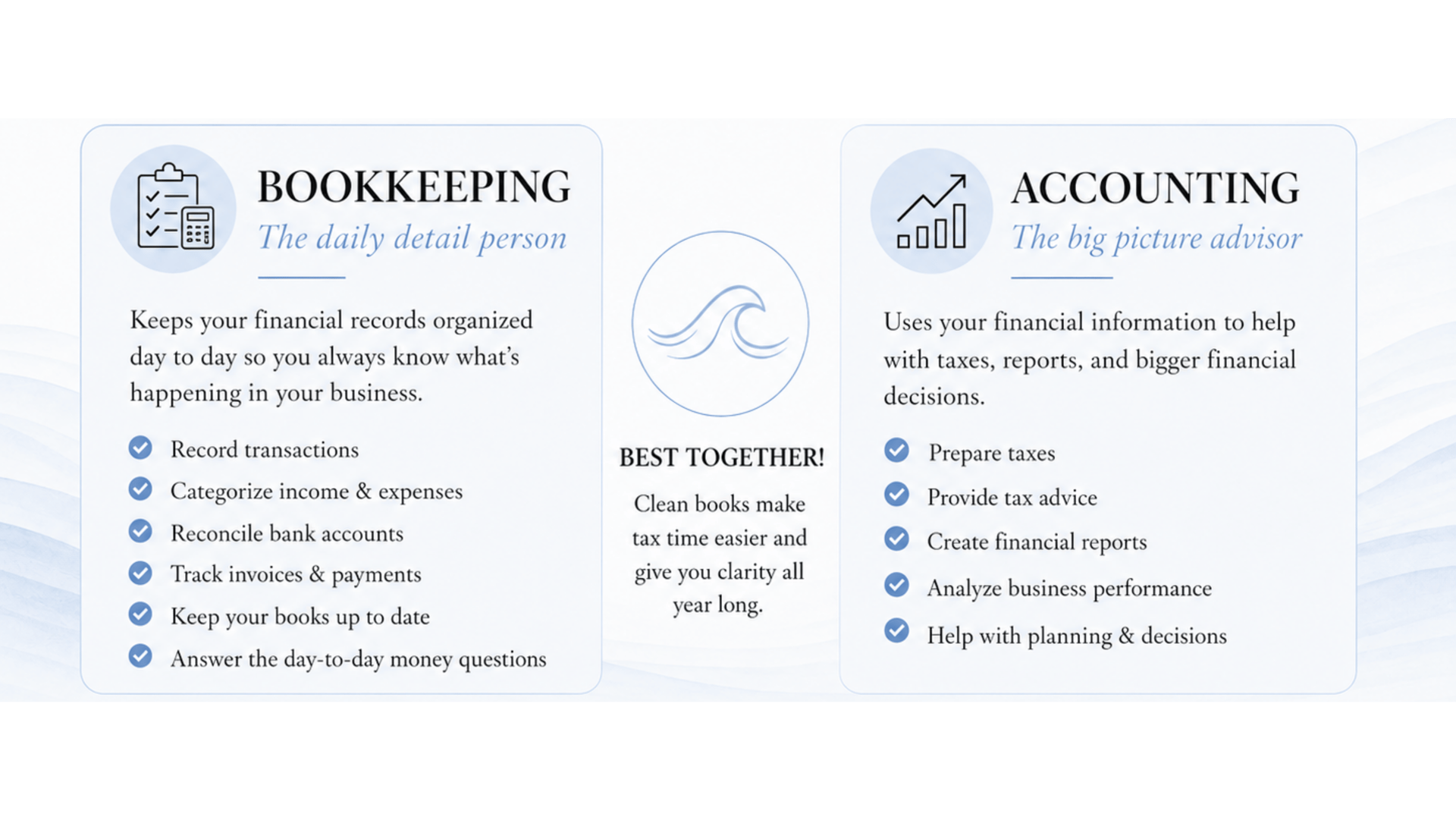
Bookkeeping keeps your financial records organized day to day.
Accounting uses those records to help with taxes, reporting, and bigger financial decisions.
Both matter, but here’s the important part: if your bookkeeping is behind, messy, or living somewhere between a shoebox of receipts and a “miscellaneous” category in QuickBooks, the accounting side is going to be a whole lot harder.
What Does a Bookkeeper Do?
A bookkeeper helps keep up with the everyday financial details of your business.
That can include recording transactions, categorizing income and expenses, reconciling bank accounts, organizing receipts, tracking invoices, and keeping your books updated throughout the year.
In regular business owner language, a bookkeeper helps answer questions like:
Where did my money go this month?
Are my accounts reconciled?
Who still owes me money?
Are my expenses coded correctly?
Are my books ready for my CPA?
Am I actually making money, or does it just feel like I’m working nonstop?
Because let’s be honest — a business can be busy and still feel broke. And that is not a fun guessing game.
A lot of business owners start out doing their own bookkeeping, and that makes sense in the beginning. But as the business grows, so do the receipts, payments, expenses, invoices, and “I’ll deal with that later” moments.
And suddenly, “later” has turned into three months of transactions and a QuickBooks screen you do not want to make eye contact with.
That is where a bookkeeper can be a huge relief.
What Does an Accountant Do?
An accountant or CPA usually looks at the bigger financial picture.
They may help with tax preparation, tax advice, financial reports, and higher-level planning. They use your financial information to help you understand how your business is performing and what decisions you may need to plan for.
But your accountant needs clean, accurate bookkeeping to work from.
If your books are behind or messy, tax time can quickly turn into a stressful treasure hunt.
And not the fun kind.
Clean bookkeeping helps your CPA do their job better, and it helps you feel more prepared when tax season comes around.
Why Bookkeeping Matters All Year Long
A lot of business owners only think about bookkeeping when taxes are due.
Understandable. Tax season has a way of showing up like an uninvited guest with a clipboard.
But bookkeeping is not just a once-a-year task.
When your books are current, you can see what is happening in your business month by month. You can better understand where your money is going, what expenses are increasing, who still owes you, and whether your business is actually making a profit.
That matters because your bank balance does not always tell the whole story.
You may have money in the bank but still have payroll, bills, taxes, loan payments, or upcoming expenses waiting their turn.
Good bookkeeping gives you a clearer picture, so you are not making decisions based on vibes, panic, or whatever the bank balance says that morning.
Why Hiring a Bookkeeper Can Help
Hiring a bookkeeper is not just about having someone enter numbers into QuickBooks.
It is about having support.
It is about knowing your books are being looked at consistently.
It is about not spending your nights or weekends trying to remember what that one random charge was from two months ago.
Was it supplies? A subscription? Something for the business? A gas station snack situation?
We have all been there.
For many small business owners, bookkeeping gets pushed to the bottom of the list because there is always something more urgent happening. Customers need help, jobs need to be finished, employees need answers, and the emails are not going to answer themselves.
A bookkeeper helps take that weight off your plate and keeps the financial side from turning into one more thing constantly hanging over your head.
Bookkeepers and Accountants Work Best Together
A bookkeeper and an accountant are not meant to replace each other.
They work best as a team.
Your bookkeeper keeps your records clean and current.
Your accountant or CPA uses those records for taxes, planning, and financial guidance.
When both are working together, everything runs smoother. Your reports make more sense, your CPA has better information, and tax season feels a lot less overwhelming.
Basically, clean bookkeeping gives everyone a better starting point.
And your future self will thank you for that.
The Bottom Line
Bookkeeping and accounting are connected, but they are not the same thing.
Bookkeeping keeps your financial records organized and up to date.
Accounting uses those records to help with taxes, reporting, and bigger financial decisions.
If you are a small business owner trying to do everything yourself, bookkeeping may be one of the first things worth handing off.
“When you pass through the waters, I will be with you; and when you pass through the rivers, they will not sweep over you. When you walk through the fire, you will not be burned; the flames will not set you ablaze.” — Isaiah 43:2 (NIV)
Scripture quotations taken from The Holy Bible, New International Version®, NIV®. Copyright © 1973, 1978, 1984, 2011 by Biblica, Inc.™ Used by permission. All rights reserved worldwide.